The Bottle
160 facets.
One object.
The bottle was designed the way the water was made: nothing decorative, nothing wasted. A square prism, cut like a diamond, to catch and carry the light.
The object

Cut like a diamond — considered to be held, and to catch the light.
Reduced to its essence. Nothing more is needed.
The diamond cut
The light does the rest.

The body is a square prism scored with 160 facets — the same geometry a jeweller cuts into a stone. Against the dark they take a single light and scatter it. Nothing here is decoration; every plane is a decision.
Even the crown is ours: the cap is moulded in-house, like the bottle it seals — one object, made whole under one roof.
Design decisions
A square answer to a round assumption.
Bottled water is round by default. The MOMA bottle is a square prism by choice — because the form should say what the water says: that a decision was made, and held.
And the shape earns its keep twice over: a square packs tight — more water in the same space, less air shipped. Considered to be held, and considered to travel.
up to 20%more bottles in the same shipping space than a round bottle of the same volume — the room a cylinder would otherwise carry as air.*
* Estimate based on packing density: a round bottle leaves roughly a fifth of a case as air between bottles, where a square prism nests almost flush. Actual gains vary by carton, pallet and container configuration.
The same diamond runs from the label to the building itself — cut into the entrance of the facility where every bottle is made.
Considered in use
Designed around
your day.
Most bottles are drawn tall, because tall reads well on a shelf. MOMA is proportioned for everything that happens after the shelf — where a bottle is held, packed, carried and poured. Lower and square, it does not loom over the setting, does not roll, and stays exactly where you set it.
Nothing about the height is an accident. It is the same discipline as the water: remove what performs, keep what serves.
On the table
Low and square — it stays where you set it, even when everyone is reaching.
In a bag
Short enough for a handbag, not only a tote.
In the car
Drops into the console without fighting the gear shift.
On the tray
Compact enough for an airline service tray.
Not a studio claim
The console test, passed — low enough to sit beside the gear shift, square enough to stay put.

Against the default
Round is easy. That is the only reason it is everywhere.
A round bottle spins through a filling line in any orientation — no alignment, no fuss, maximum speed. A square has to be turned, registered and handled to a finer tolerance, and it gives that speed back on every shift. Faced with that maths, the industry chose round. Not better — just easier.
We make our own bottles, so we could choose the harder answer and build the line to run it. What we give up in speed, you gain in the object — the same water in less space, a base that sits steady, a face that reads like a decision, not an inheritance.
Tall is a habit. Round is easy. Square was a decision.
Made, not bought
We make the bottle, too.
The bottle is not bought in and filled. It is made on site — every preform and every cap moulded in-house, then inspected by camera before a drop of water ever reaches it.
It is the same conviction as the water: when you control every step, you can answer for every bottle. Moulded, inspected and sterile-filled on one automated line — in South-East Asia’s first fully-automated facility.
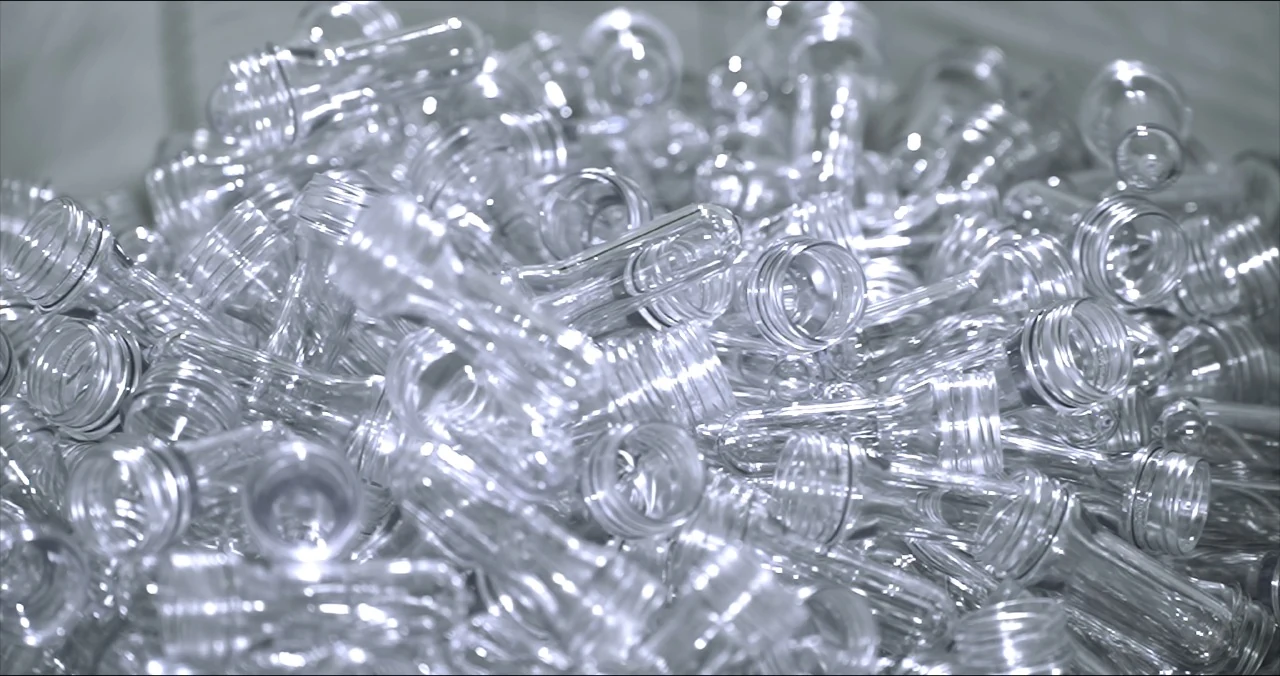
The preforms, before the bottle — moulded in-house, on our own line.
Three formats
For the pocket, the day, the table.

The pocket.

The everyday.

The table.